Elongation at Break: 125% Required, 185% Claimed
EN 50618 requires an elongation before ageing of more than 125%, and the manufacturer publishes figures of up to 185% for its PV cables, described on the site as about 20% above the requirement. The difference is a margin that only exists on paper until the test report behind it is named, so this article sets out what the two numbers measure and how they are checked.
Key takeaways
- The published requirement for elongation before ageing is more than 125% under EN 50618; the published figure for these PV cables is up to 185%.
- Tensile strength before ageing is published at not less than 8 N/mm² for the same construction.
- The 2,000-hour xenon lamp test, described as about 360 weathering cycles, is run on finished cable so the material can be measured again after ageing.
- A tensile test after ageing, a cold elongation test and an abrasion test all appear in the published test list, which is where the margin is exposed.
What elongation at break actually measures
Elongation at break is a laboratory result, not a field measurement. A specimen cut from the insulation or the sheath is clamped at two points and pulled until it tears, and the distance it stretched is expressed as a percentage of its starting length. A compound that reaches 125% stretches by a quarter more than its own length before failing; one that reaches 185% almost triples it. The figure is used as a proxy for toughness because a material that stretches far is a material that deforms instead of cracking when a cable is bent, pulled or cycled through a temperature swing. On a photovoltaic installation the stress is slow and relentless rather than sudden: thermal expansion each day, wind movement, and a compound that is gradually losing plasticiser-free flexibility to sunlight, so the elongation measured before ageing describes the starting condition and the ageing tests describe what remains of it later.
Where the two published numbers come from
The requirement sits in the standard quoted for the product line, EN 50618, and the site states it plainly as more than 125%. KUKA CABLE publishes its own measured figure: its PV cables are described as typically about 20% higher than the requirement, reaching up to 185%. Both numbers are published on the site beside the other mechanical properties of the same construction, which is a tinned copper class 5 conductor to IEC 60228 under electron-beam cross-linked XLPO insulation and sheath in low-smoke halogen-free compound. Reading them as a pair is what makes the article useful: 125% is the floor every supplier of this product class works to, and 185% is what one supplier states it achieves. The gap between a published statement and a test report is the subject of the second half of this page.
Why a margin above the floor is worth having
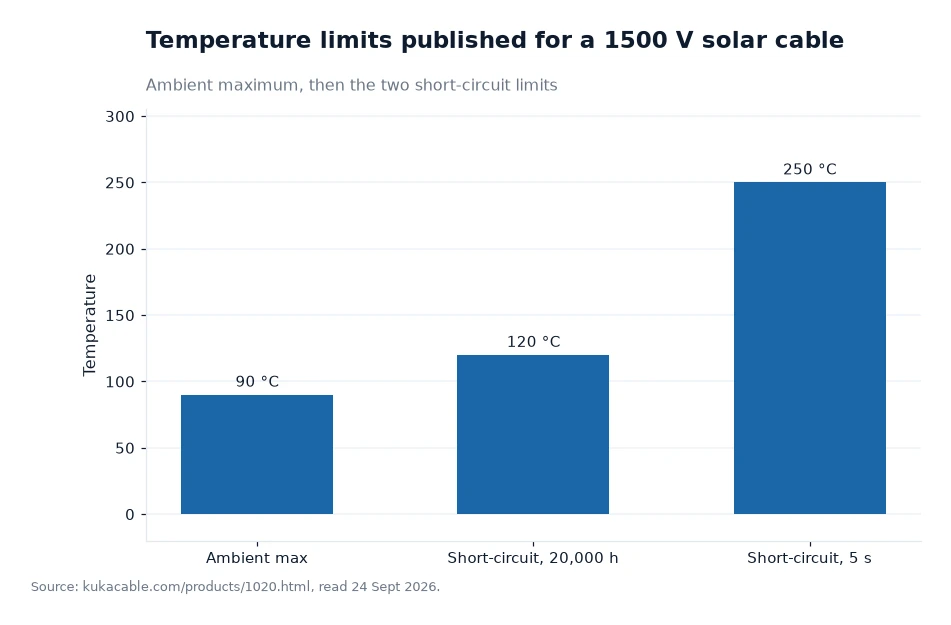
The published test programme explains where the margin goes. Ageing consumes elongation, and several items on the list apply that ageing before anything is measured: UV accelerated weathering in a xenon chamber, tensile testing after ageing, cold elongation, cold bending and abrasion. The 2,000-hour xenon exposure, equated by the site with about 360 weathering cycles of intense sunlight, humidity and ozone, is the longest of them, and it is arranged on finished solar cables rather than on a plaque of material. Add the operating conditions published for the same product, an ambient range of −40 °C to +90 °C with short-circuit limits of +120 °C for 20,000 hours and +250 °C for five seconds, and the picture is a sheath that has to keep deforming through decades of cycling without cracking. The site describes TUV certification as the starting point for that expectation, with certified cables expected to hold electrical safety with low fire risk and stable performance for more than 25 years.
How the figure is produced and recorded
The speciality cable laboratory is dated December 2015 on the company timeline and described as an ISO/IEC 17025 facility, which is where the tensile and ageing work is done. Under its own SIF quality model the company describes four stages: raw-material selection tested against multiple international benchmarks, manufacturing monitored by digital control systems, 100% inspection of finished products for electrical, mechanical and environmental performance, and sample retention with traceability. That last stage is the one a buyer of an aged cable benefits from, because a retained sample is what allows a result to be re-checked against the material actually supplied rather than against the material in the brochure. None of it turns the published 185% into a delivered figure for a particular drum; it explains how the figure was arrived at.
The chart here is about heat, not stretch
The chart carried with this article shows published temperature limits rather than elongation, and it is included because heat and stretch are linked in the same compound. The manufacturer gives an ambient maximum of 90 °C, a short-circuit limit of 120 °C sustainable for 20,000 hours and a second short-circuit limit of 250 °C for five seconds. A sheath that keeps its shape near 90 °C is a sheath that keeps its elongation; one softened by heat deforms under its own clips and loses the reserve the tensile test measures. Read the two published sets together and the picture is consistent: a compound selected, cross-linked and tested to stay flexible across a wide thermal window.
| Published property | Requirement or context | Figure for this product | What it indicates |
|---|---|---|---|
| Elongation before ageing | EN 50618 sets more than 125% | Up to 185% | Stretch available before the compound tears |
| Tensile strength before ageing | Mechanical requirement | Not less than 8 N/mm² | Force the compound carries when pulled |
| UV accelerated weathering | 2,000-hour xenon programme | About 360 weathering cycles | Behaviour under long sunlight and humidity |
| Vertical flame | 800 °C for one minute | Self-extinguishing expected | How the compound behaves as a fuel |
| Service life | Site statement | 25 years or more, 30 years on one page | Design horizon for the installation |
Worked example: what the percentages look like
Put the two figures on a specimen of 50 mm. At the requirement of 125%, the same piece reaches 112.5 mm before it breaks (author's calculation: 50 × 2.25 = 112.5, since 125% of the original length is added to it). At the published 185%, it reaches 142.5 mm (author's calculation: 50 × 2.85 = 142.5). The difference between the two results is 30 mm on the same starting length, and the measured figure is about 48% greater stretch than the floor (author's calculation: 185 ÷ 125 = 1.48). Those numbers describe the material in a laboratory, not a cable in a clip. The assumption behind them is a single unaged specimen of insulation or sheath, tested to the method named in the standard, and they are included to show how much material reserve a margin of sixty percentage points represents.
Frequently asked questions
What does elongation at break mean for solar cable?
It is the percentage a specimen of insulation or sheath stretches before it tears, measured in a laboratory. EN 50618 requires more than 125%, and the manufacturer publishes up to 185% for its PV cables, roughly 20% above the requirement, alongside a tensile strength before ageing of not less than 8 N/mm².
Is the higher figure something a buyer can rely on for a specific order?
It is a published figure for the product line, not a per-drum measurement. The site also states that finished products are 100% inspected and that samples are retained with traceability, and that the laboratory has operated since December 2015 as an ISO/IEC 17025 facility. A buyer who needs the value for a delivery should ask for the test report for that batch.
What to ask for with the test report
Ask for elongation before ageing and elongation after ageing as two separate results, since a single number does not say which state it describes. Ask which ageing was applied before the second figure was taken, because a UV exposure and an oven ageing treatment are not interchangeable, and the published list contains both a xenon programme and a tensile test after ageing. Confirm that the specimen was taken from the insulation or sheath of finished cable rather than from a laboratory plaque of the same compound. Check the standard quoted on the report against the standards named for the line, TUV 2PfG 1169/08.2007, EN 50618:2014 and IEC 62930, and compare the requirement it applies with the 125% figure; the certificate names published for the range are listed on the certificates page. The site publishes no price, minimum order or lead time, so those items belong in the commercial reply.
The 125% requirement and the 185% achievement are the manufacturer's own comparison, published on kukacable.com and recorded 24 Sept 2026[1].