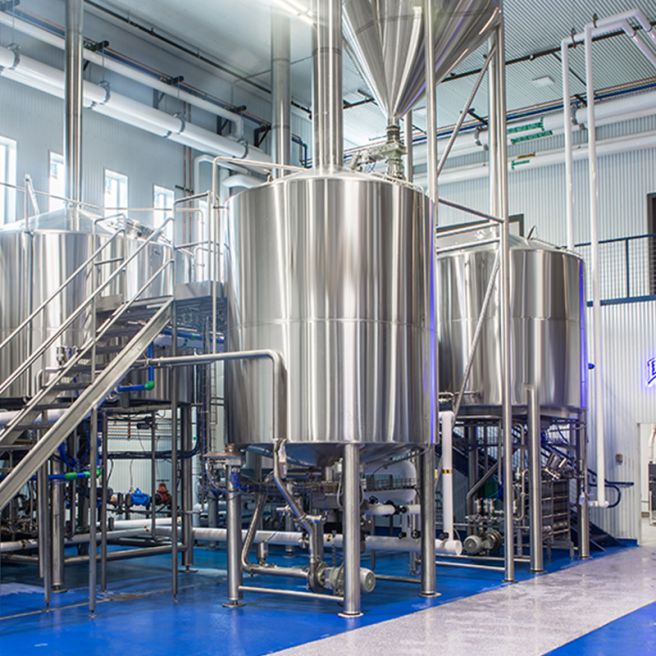
A modern brewhouse improves beer quality by controlling temperature, pH, flow, oxygen, wort gravity, and sanitation within repeatable limits. Mash temperatures often sit between 63–72°C, while mash pH is commonly held around 5.2–5.6. Lauter efficiency may reach 90% or more in well-designed systems, and modern kettles can operate at evaporation rates near 4–10% per hour depending on design. Automated valves, flow meters, pressure sensors, and recipe controls reduce operator variation. Plate heat exchangers can cool wort from near boiling to fermentation temperature in minutes. Better control produces more consistent wort, giving yeast a more stable starting point for every batch.
Beer quality starts with mash chemistry because malt enzymes respond quickly to small temperature changes. Beta-amylase works strongly around 60–65°C, while alpha-amylase remains more active closer to 68–72°C. A difference of only 2°C can change the ratio of fermentable sugars to dextrins, which later affects attenuation, body, and alcohol level. A brewery producing a 5.0% ABV pale ale across 50 batches needs a stable sugar profile if it expects the final alcohol result to stay inside a narrow specification.
Modern mash vessels use several temperature probes, automated steam control, and variable-speed mixing to reduce uneven heating. A vessel may show 66°C at one probe while poorly mixed zones sit several degrees higher or lower. Continuous agitation and controlled heating reduce those differences. In a well-configured brewery system, operators can store mash steps, water volumes, rest times, and heating rates instead of adjusting every valve manually.
Temperature control is useful only when the measurement represents the whole mash. One accurate sensor in the wrong location can still give a misleading reading.
pH control comes next because enzyme activity, protein behavior, and extraction all depend on acidity. Brewers commonly target mash pH between 5.2 and 5.6, measured under defined conditions. Water chemistry changes that number. Calcium levels of roughly 50–150 mg/L are common in many brewing profiles, while sulfate and chloride are adjusted according to the intended flavor balance. A pale ale with 150 mg/L sulfate can taste noticeably different from the same recipe brewed with a chloride-heavy water profile.
Precise water dosing therefore matters as much as temperature. Automated systems can measure strike water by volume or mass, dose treatment chemicals, and repeat the same liquor-to-grist ratio across every batch. If a recipe uses 1,000 kg of malt and a 3:1 liquor-to-grist ratio, even a 3% water error adds or removes about 90 liters from the mash. That difference can affect mash thickness, heating behavior, extraction, and later wort gravity.
Once conversion is complete, lautering becomes a balance between yield and wort quality. Modern lauter tuns monitor pressure below the grain bed, runoff flow, sparge volume, and rake position. Runoff that is too fast can compact the bed, while excessive sparging may raise pH and increase extraction of husk-derived polyphenols. Commercial brewhouse efficiency can exceed 90%, but chasing the highest possible number is not always useful if wort quality becomes less consistent.
A 20 hL brewhouse losing 2% of expected extract on every batch may appear to have a small efficiency problem. Across 500 annual brews, the accumulated malt use becomes significant. Better flow control allows operators to recover more useful extract without extending runoff or washing the grain bed excessively. Pressure sensors also show when the bed begins to tighten, allowing pump speed or rake movement to be adjusted before filtration slows sharply.
Boiling then changes wort concentration, protein structure, hop utilization, and volatile compounds. Traditional systems often evaporate about 8–12% of kettle volume per hour, while many modern low-energy designs operate closer to 4–8%. A brewery starting with 10,000 liters of wort would lose 1,000 liters at a 10% evaporation rate but only 600 liters at 6%. Lower evaporation can cut steam and water use, provided the system still achieves the required wort treatment.
Kettle geometry and circulation matter because boiling is not simply a temperature target. Atmospheric pressure changes the boiling point, and poor circulation can create uneven heat treatment. Modern internal or external wort boilers move wort through controlled heating zones, producing more predictable evaporation and protein coagulation. Steam pressure, boil time, vessel level, and energy input can all be stored as batch data.
A vigorous-looking surface does not prove that the whole wort volume is receiving the same heat treatment.
Hop additions benefit from the same level of measurement. Alpha-acid content can vary by crop year and lot, so a 10 kg addition from one shipment may not provide the same bitterness contribution as 10 kg from another. If one lot contains 12% alpha acids and another contains 9%, the difference is 33% relative to the lower-alpha lot. Automated dosing improves weight and timing accuracy, while recipe management makes it easier to adjust quantities when laboratory data changes.
Whirlpool performance affects how much trub enters fermentation. Inlet position, velocity, vessel geometry, stand time, and outlet design all affect solids separation. A controlled transfer can form a more stable trub cone and reduce carryover into the heat exchanger. Brewers do not always want zero trub, since some material may support yeast nutrition, but variation from batch to batch makes fermentation harder to compare.
Cooling follows immediately, and speed matters. Wort may leave the whirlpool above 90°C and needs to reach roughly 8–12°C for many lagers or around 16–22°C for many ales. A properly sized plate heat exchanger can achieve that reduction during a single pass. If 5,000 liters of wort reaches the fermenter 3°C warmer than target, yeast activity can start differently from the previous batch before temperature control fully catches up.
Heat exchangers also recover energy. Warm cooling water leaving the exchanger can be collected for the next mash or for cleaning. Some breweries recover water above 70°C, reducing the amount of steam required for the next production cycle. Energy savings vary by plant layout, but heat recovery can reduce total thermal demand by a measurable percentage over hundreds of brews per year.
Sanitation has an equally strong effect on beer quality. Product-contact surfaces need hygienic welds, drainable piping, suitable gaskets, and cleaning coverage. Clean-in-place programs commonly control chemical concentration, temperature, flow, and contact time. Caustic cleaning solutions may be used around 1–3% concentration depending on soil load, equipment, and chemical supplier instructions.
Automated CIP reduces variation between operators. A manual rinse lasting 8 minutes on one shift and 15 minutes on another may not produce the same result. Conductivity sensors can confirm whether cleaning chemicals have reached the expected concentration, while flow monitoring shows whether pumps are supplying enough turbulence through pipes and spray devices. Records from 100 or more cleaning cycles also help maintenance teams notice gradual changes in pump performance or heat-exchanger pressure drop.
Oxygen control becomes more important as wort moves toward fermentation and finished beer. Yeast requires controlled oxygen before or at pitching, but unwanted oxygen later can shorten flavor stability. Modern transfer systems use closed piping, controlled pump speeds, and carefully designed vessel fills to reduce splashing. On the cold side, many packaged breweries aim for dissolved oxygen levels measured in tens of parts per billion rather than parts per million.
Process data ties all of these operations together. Temperature, pH, pressure, flow, volume, gravity, valve position, and cleaning records can be linked to a batch number. If attenuation falls from 80% to 76% across 6 consecutive batches, the brewing team can compare mash temperature, wort gravity, yeast pitch, oxygenation, and fermentation records instead of relying on memory.
The same data helps during scale-up. A recipe developed on a 5 hL pilot brewhouse will not behave exactly the same on a 50 hL production system. Heating rate, evaporation, mixing, hop utilization, and vessel geometry all change with scale. Stored process values give brewers measurable targets to adjust during the first 3–10 commercial batches rather than copying ingredient quantities alone.
Modern equipment does not remove brewing skill. It gives brewers tighter control over the variables that shape wort before fermentation. When mash temperature, pH, extraction, boil performance, cooling, oxygen exposure, and cleaning stay within defined ranges, batch-to-batch variation becomes smaller and quality problems become easier to trace.